Michigan Cyclosporiasis Cases Hit Shocking 6571 in Outbreak
Health & Public Safety · July 21, 2026
Michigan Cyclosporiasis Cases Soar to Alarming 6571 in Historic Outbreak
State health officials report the fastest-growing foodborne parasite crisis in US history, now spanning 55 counties — with 102 hospitalized, no confirmed food source, and no end in sight.
Michigan cyclosporiasis cases climbed to a staggering 6,571 on Tuesday, July 21, 2026, according to the Michigan Department of Health and Human Services (MDHHS), marking yet another alarming daily surge in what state officials have described as potentially the largest cyclosporiasis outbreak in the history of the United States. The case count has accelerated at a pace that has left epidemiologists and public health officials struggling to keep pace — rising from just 170 confirmed infections on June 30 to more than 6,500 in under four weeks, with no confirmed food source yet identified and the CDC warning that new illnesses are expected to continue through at least late August.
MDHHS reports 6,571 total Michigan cyclosporiasis cases since June 22 — a daily increase of 423 from the 6,148 reported on July 20.
Case count reaches 6,148 — up 1,146 from the 5,002 reported on July 17, representing an average of more than 380 new infections per day over the weekend.
FDA retracts an earlier positive Cyclospora test on Taylor Farms iceberg lettuce, calling it a “false positive.” The outbreak source is officially back to unidentified.
CDC formally identifies a 5-state cluster of 1,644 illnesses in Indiana, Kentucky, Michigan, Ohio, and West Virginia linked to shredded iceberg lettuce at select Taco Bell locations sourced from a single supplier in central Mexico.
Michigan hospitalizations cross 100 for the first time; MDHHS confirms 102 patients have received inpatient treatment — more than double the 44 reported the week prior.
MDHHS announces testing points to lettuce or salad greens as a “potential source”; updated restaurant guidance issued to all Southeast Michigan commercial kitchens.
MDHHS and MDARD officially declare an outbreak investigation underway, with cases concentrated in Monroe, Lenawee, Washtenaw, and Wayne counties.
Michigan Cyclosporiasis Cases Reach an Unprecedented Scale
To grasp the gravity of what is unfolding in Michigan, a single statistic stands above the rest: the state typically records approximately 50 cyclosporiasis cases per year. As of Tuesday morning, Michigan cyclosporiasis cases have surpassed 6,571 — more than 131 times the annual baseline — in fewer than four weeks. The outbreak, which MDHHS formally began tracking on June 22, has accelerated at a pace that researchers and public health veterans say they have never previously witnessed for this particular parasite on American soil.
Michigan officials have explicitly stated this could be the largest cyclosporiasis outbreak in United States history. That assertion gains weight when placed alongside national historical data: even in 2018 — previously the worst year on record for the illness — the entire country reported 3,519 laboratory-confirmed cases over the full year. Michigan alone has now surpassed that total nearly twice over in a single month.
The geographic spread of the illness has proven equally alarming. What began as a cluster confined to Monroe County in Southeast Michigan has now touched 55 of the state’s 83 counties. The outbreak is most intense in the densely populated corridor running through Washtenaw, Wayne, and Oakland counties, but infections have been confirmed in communities well beyond the initial epicenter, reaching rural areas across the Lower Peninsula. MDHHS updates its daily case tally on weekdays at 11:00 a.m. Eastern Time, and the trajectory — consistently upward — has shown no sign of leveling off.
What Is Cyclosporiasis and How Does It Spread?
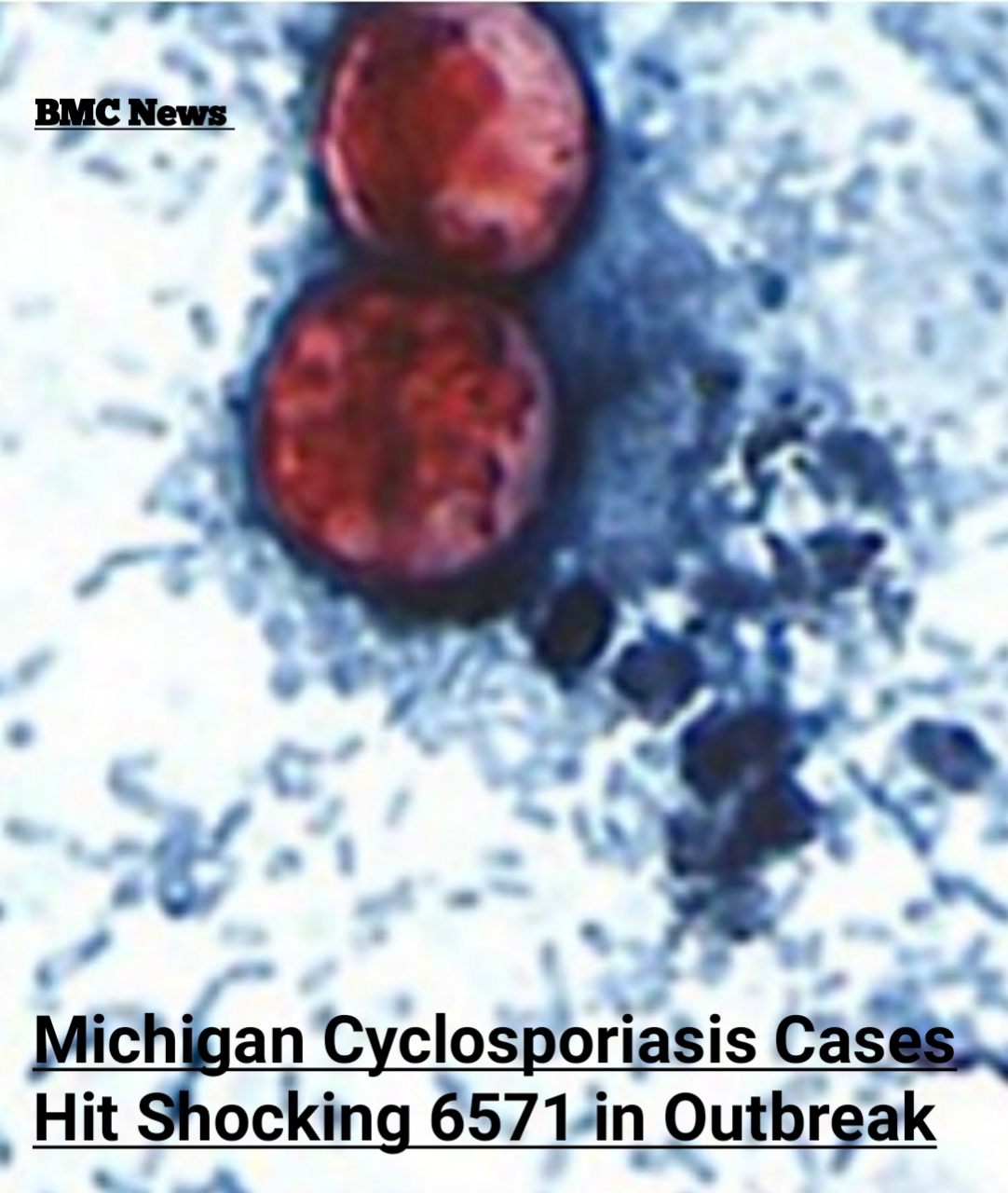
Cyclosporiasis is an intestinal illness caused by Cyclospora cayetanensis, a single-celled microscopic parasite that invades the small intestine. Infection occurs when a person swallows food or water contaminated with feces containing the parasite’s oocysts — a hardy dormant form capable of surviving on the surface of fresh produce even after washing with running water. Critically, the parasite is not spread from person to person; it requires a period outside the human body to become infectious, meaning exposure to a sick individual carries no direct transmission risk.
Symptoms typically emerge about one week after exposure, though the incubation window ranges from two days to more than two weeks. The hallmark presentation is frequent, watery, and sometimes explosive diarrhea — often severe enough to cause dangerous dehydration. Additional symptoms include loss of appetite, persistent bloating and stomach cramping, nausea, fatigue, body aches, headaches, and vomiting. Without antibiotic treatment, the illness can persist from a few days to more than a month, and symptoms are known to resolve and then return in relapsing cycles — a characteristic that often delays diagnosis.
Treatment is a 10-day course of the oral antibiotic trimethoprim-sulfamethoxazole (TMP-SMX), sold commercially as Bactrim, Septra, or Cotrim. A critical complication for diagnosis is that Cyclospora is not detected by standard stool testing panels. Clinicians must specifically request a test targeting Cyclospora cayetanensis, and molecular testing methods have been shown to be more sensitive than conventional microscopy. Both the CDC and MDHHS have urged healthcare providers across the country to maintain a high index of suspicion, particularly in patients presenting with prolonged or relapsing watery diarrhea who have recently consumed fresh produce.
“Although we do not have a definite product identified as the source of the outbreak, we want to let Michiganders know what we have learned so far so they can take steps to protect their families. Early information has shown lettuce as a common product that regularly comes up during the investigation.”
— Dr. Natasha Bagdasarian, Chief Medical Executive, Michigan MDHHS, July 13, 2026
Taco Bell, Taylor Farms, and the Unresolved Search for the Source
The question of which specific food vehicle is driving the outbreak has become one of the most consequential — and frustrating — threads of the investigation. On July 13, MDHHS announced that testing had identified lettuce or salad greens as a “potential source,” prompting immediate guidance to Southeast Michigan restaurants and commercial kitchens to switch from pre-washed bagged mixes to whole-head lettuce, discarding the outer two to three layers before washing the interior leaves under running water.
Federal investigators, working alongside state officials, began scrutinizing Taco Bell restaurants as a possible common link after some patients who became ill reported eating at the chain — though others who got sick had no connection to the fast-food company, indicating the outbreak extends well beyond any single restaurant. On July 18, the CDC and FDA issued a formal consumer advisory against eating shredded iceberg lettuce at select Taco Bell locations in five states: Indiana, Kentucky, Michigan, Ohio, and West Virginia. Authorities noted that shredded iceberg lettuce sold in grocery stores or served at other restaurants was not believed to be affected by this particular advisory.
Taylor Farms, a major produce supplier for the chain, voluntarily removed all iceberg lettuce sourced from central Mexico from US distribution while investigators worked to confirm whether their product was the vehicle of infection. Then, in a significant and disorienting reversal, the FDA announced on Sunday that a sample of Taylor Farms iceberg lettuce that had initially returned a positive Cyclospora result was in fact a false positive — created by a laboratory error, not contamination in the supply chain. With that lead retracted, the source investigation stands once again with no confirmed culprit, even as Michigan cyclosporiasis cases continue to multiply every single day.
“Outbreaks of cyclosporiasis have been occurring across the United States and now here in Michigan.”
— Dr. Natasha Bagdasarian, Chief Medical Executive, Michigan MDHHS, June 30, 2026
Southeast Michigan: Ground Zero of the Crisis
While cases have been confirmed across 55 of Michigan’s 83 counties, the burden of illness remains heavily concentrated in Southeast Michigan. Wayne County has recorded at least 582 cases, Washtenaw County has reported 474, and Oakland County has logged 396. Jackson, Livingston, Monroe — where the outbreak was first detected — and Shiawassee counties also carry significant caseloads. By contrast, counties farther from the outbreak’s epicenter, such as Macomb County, have reported comparatively lower totals.
Demographically, working-age adults bear the greatest share of confirmed infections. MDHHS data shows that adults aged 30 to 39 account for approximately 22% of all cases — close to 1,000 individuals — making them the single largest age cohort affected. Adults between the ages of 20 and 49 collectively represent the majority of all reported infections, with fewer cases among children and older adults. Officials have not provided a definitive explanation for this age skew, though dietary habits and dining patterns among that demographic group are likely contributing factors under active investigation.
A National Crisis Expanding Across 34 States
Michigan’s outbreak, while by far the most severe in the country, is one part of a much broader and rapidly escalating national surge. The CDC has received 1,645 laboratory-confirmed domestically acquired Cyclospora infections spanning 34 states since May 1, 2026, with more than 5,100 additional cases awaiting further analysis to determine whether they too were acquired within the United States. For context, during the same period in 2025, the CDC had received only 249 reports of domestically acquired cyclosporiasis — making this year’s surge more than six times larger than the year prior at the same point in the season.
Nationally, 141 confirmed case patients — representing 9% of those for whom clinical information is available — have been hospitalized. No deaths attributable to the outbreak have been reported as of the most recent federal update. Patient ages span the entire range from 2 to 95 years, with a median age of 44. A WHO official has warned that the true toll of the outbreak may be two to four times larger than confirmed numbers reflect, citing systemic underdiagnosis caused by clinicians ordering the wrong tests and the lag inherent in public health reporting systems.
Adding to public health concerns, the CDC’s FoodNet surveillance program — the primary federal mechanism for tracking foodborne illness — made Cyclospora reporting optional as of July 1, 2025, a policy decision that health advocates argue has meaningfully hampered the agency’s ability to detect and respond rapidly to outbreaks of precisely this type.
- Michigan cyclosporiasis cases stand at 6,571 as of July 21, 2026 — up from 170 on June 30, within less than four weeks.
- Michigan’s typical annual caseload is approximately 50 infections per year; this outbreak has exceeded that figure by more than 131 times.
- At least 102 people have been hospitalized in Michigan; the hospitalization count is updated weekly on Thursdays. No deaths have been reported.
- The outbreak has spread to 55 of Michigan’s 83 counties; Southeast Michigan — particularly Wayne, Washtenaw, and Oakland counties — carries the highest burden.
- The CDC has identified cases in 34 U