Lebanese Army Enters Southern Lebanon: Urgent Test of Deal
MIDDLE EAST · JULY 21, 2026
Lebanese Army Enters Southern Lebanon Town as Israel Withdraws
In a first real test of a US-brokered framework, Lebanese troops moved into Zawtar al-Gharbiyeh hours before President Joseph Aoun met Donald Trump at the White House to press for a full Israeli pullout.
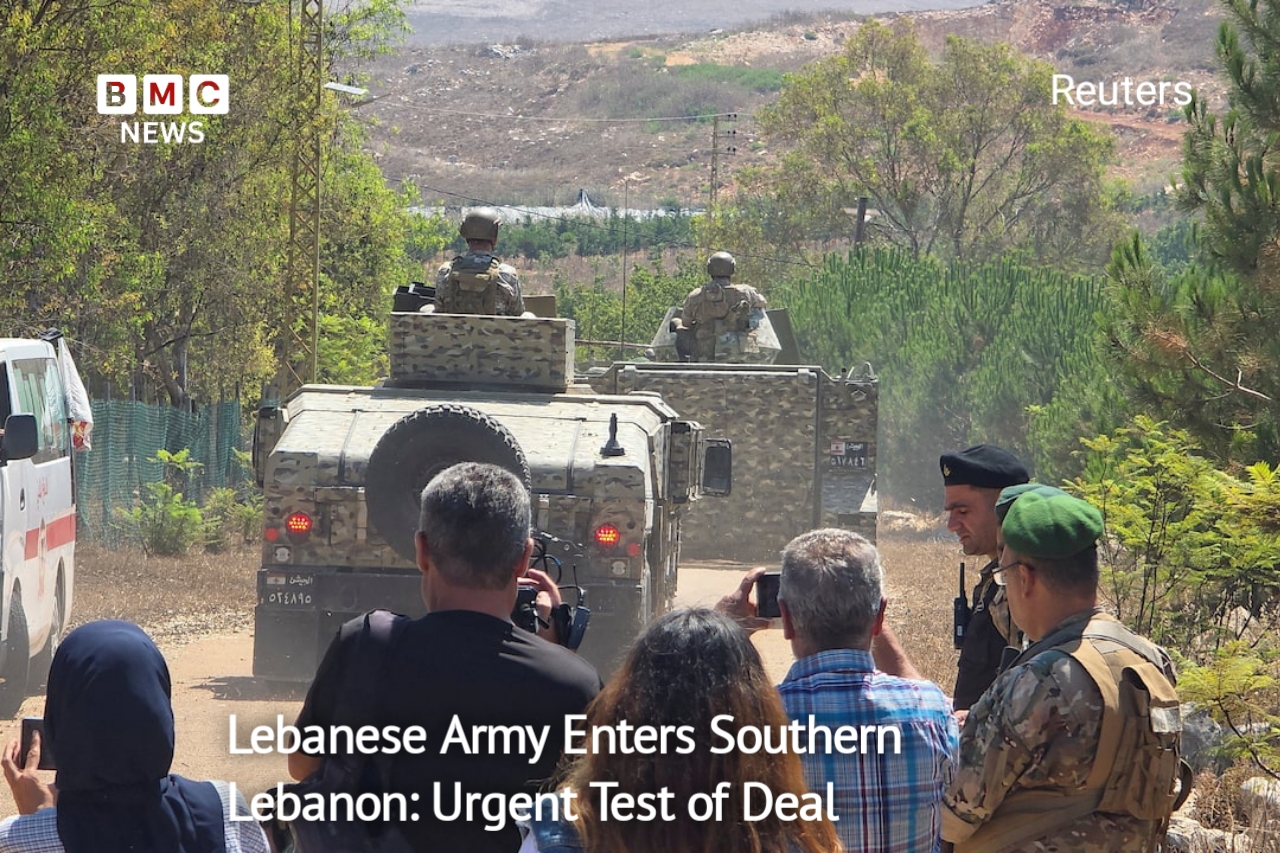
Lebanese army enters southern Lebanon territory it has not controlled in years, rolling into the town of Zawtar al-Gharbiyeh on Tuesday only hours after Israeli forces pulled out of the area, in what officials on both sides describe as the first genuine test of a US-brokered framework agreement signed on June 26. Military jeeps, armored vehicles and an engineering team were filmed moving into the town, which sits in the Nabatieh region beyond the so-called Yellow Line that has marked the edge of Israeli-controlled ground since the last war between Israel and Hezbollah.
The deployment, confirmed by a senior Lebanese security official, was the opening move in a three-village “pilot zone” program that the U.S. State Department said had begun over the weekend. Under the arrangement, the Lebanese army is also expected to move into the villages of Froun and Srifa in the coming days, gradually replacing an Israeli military presence that has stretched across a strip of territory roughly 10 kilometers deep into Lebanese soil since fighting ended in late 2024.
An Israeli military official described the handover in blunt terms, framing it as a proving ground for Beirut’s ability to govern its own south without Hezbollah’s guns anywhere nearby.
— Israeli military official
What Happened in Zawtar al-Gharbiyeh
According to an Anadolu Agency reporter on the scene, a Lebanese army engineering regiment was first through the gates, conducting field surveys of streets to check for explosives and other remnants left behind by Israeli forces before the wider deployment moves in. Local sources said the Israeli withdrawal itself was quiet, with vehicles pulling back from the town without incident overnight into Tuesday morning. The Lebanese army has told civilians not to attempt to return to their homes until its units confirm the town is safe, a caution rooted in the reality that years of fighting have left explosive remnants scattered through much of the formerly occupied strip.
The Pilot Zone Plan, Explained
The pilot program is narrower than a full withdrawal. It covers only Zawtar al-Gharbiyeh, Froun and Srifa for now, and its purpose is as much about trust-building as territory. Under the framework, Lebanese troops are tasked with confiscating any weapons belonging to the Iran-aligned Hezbollah movement found in the handover zones, while Israel carries out phased pullbacks from positions it has held since the ceasefire that ended the 2024 war. Notably, the agreement contains no fixed timetable for completing the broader withdrawal from all of southern Lebanon. Instead, further Israeli movement is explicitly tied to the Lebanese army first demonstrating it can hold full security responsibility in each area it takes over, including disarming any armed groups operating there.
Aoun’s Historic Meeting With Trump
The timing was no accident. Lebanese President Joseph Aoun arrived in Washington over the weekend for what his office described as an official visit, becoming, according to Reuters, the first Lebanese head of state to visit the White House in nearly 20 years and the first to meet Trump face-to-face. Aoun met Secretary of State Marco Rubio on Sunday and told him plainly that Israel should begin its broader withdrawal in line with the June 26 agreement. Ahead of the trip, Aoun said he intended to press Trump directly for American leverage over Israel.
— Lebanese President Joseph Aoun, on his goal for the Trump meeting
A senior Lebanese official told Reuters that Aoun believes only Trump carries enough weight to push Israel toward a genuine withdrawal and help Lebanon reclaim full sovereignty over its own south. As part of Tuesday’s talks, Aoun was expected to hand Trump a written proposal laying out how Hezbollah’s arsenal could realistically be dismantled — a plan years in the making and one that has already drawn resistance from the group itself.
Why Hezbollah’s Disarmament Is the Real Sticking Point
Hezbollah, founded in 1982 with backing from Iran’s Revolutionary Guard, has firmly rejected both the Lebanese government’s direct engagement with Israel and the broader push to strip it of weapons. The group was badly weakened by Israel’s 2024 military campaign and by the collapse of Bashar al-Assad’s government in Syria, a longtime patron that had long served as a supply route for Hezbollah’s arsenal. Lebanese troops have already deployed across parts of the south to secure Hezbollah arms depots under the terms of the ceasefire that followed that war, doing so without armed resistance from a group that Israeli officials say remains only partially disarmed.
Israeli Skepticism Persists Despite the Handover
Even as its forces withdrew from Zawtar al-Gharbiyeh, Israel has not hidden its doubts about whether Lebanon can follow through. Israeli officials have voiced skepticism about Lebanon’s ability to fully disarm Hezbollah, even as they describe the deal reached last month as an important building block toward eventual peace between the two countries. That tension — cooperation on the ground paired with public doubt about the endgame — has defined the arrangement since it was signed.
The Human Cost Still Visible on the Ground
Whatever happens diplomatically in Washington, the physical toll of the war remains the backdrop to every handover. Dozens of villages across the formerly occupied strip have been razed, and public infrastructure — hospitals, power stations, water pumping stations — has been destroyed. Hundreds of thousands of Lebanese residents displaced by Israeli strikes are still waiting for confirmation that it is safe to go home, and Lebanese officials say that wait will not meaningfully shorten until Israeli forces complete their withdrawal from the remaining occupied ground.
What Happens Next
Attention now shifts to whether the Lebanese army will move into Froun and Srifa on the same accelerated timeline seen in Zawtar al-Gharbiyeh, and to what, if anything, emerges from Aoun’s Oval Office meeting with Trump. Lebanese officials have previously accused Israel of stalling on the pilot-zone withdrawals, and two days of U.S.-mediated talks in Rome reportedly ended without a firm implementation timetable, according to a report by The National. The broader question — whether Washington is willing to apply real pressure on Israel to leave the rest of southern Lebanon — is likely to shape whether Tuesday’s handover becomes the first of many, or a stand-alone gesture.
Key Facts
- Lebanese army entered Zawtar al-Gharbiyeh in the Nabatieh region on Tuesday, July 21, 2026.
- The move follows a full Israeli military withdrawal from the town.
- It is the first stage of a three-village U.S.-brokered “pilot zone” program.
- Froun and Srifa are expected to see similar handovers in the near term.
- The underlying framework agreement between Lebanon and Israel was signed June 26, 2026.
- The occupied strip runs roughly 10 kilometers deep into southern Lebanon.
- President Joseph Aoun is the first Lebanese head of state to visit the White House in nearly two decades.
- Aoun met Secretary of State Marco Rubio in Washington on Sunday, July 19.
- Hezbollah has rejected both direct talks with Israel and disarmament efforts.
- Israeli officials say they remain skeptical Lebanon can fully disarm Hezbollah.
Timeline: From Ceasefire to Pilot Zones
For now, the image out of Zawtar al-Gharbiyeh — Lebanese jeeps rolling past homes still scarred by war, an engineering crew scanning the ground for unexploded ordnance — stands as the most concrete sign yet that the June 26 framework is producing movement on the ground, not just paperwork in Washington. Whether that momentum survives contact with Hezbollah’s continued resistance and Israel’s public skepticism is the story Lebanon, Israel and the United States are all now watching unfold. More background on the ceasefire and prior Israeli withdrawal phases is available via Reuters’ Middle East coverage.